
What Makes a Website Actually Work for Your Business?

Imagine landing on a website where everything competes for your attention. It feels cluttered, confusing, and hard to navigate. Now picture a site that’s clean and organized, where you instantly know where to click and can find exactly what you need. It’s easy to use, feels intentional, and leaves a strong impression. The difference between the two often comes down to how your pages are structured and how the overall layout guides the user.
In this article, you will discover what makes a website convert, how a website drives business, and the impact a good layout can have on the the user experience.


What makes a website convert?
Many small business owners assume a beautiful design is enough. But the real question is not “Does my website look good?” It’s what makes a website convert? Steady traffic to your website without conversions is just digital window shopping. In short, you need to know how a website drives business, otherwise it’s just “existing.” The answer is through good clean layout, the elements that go into it so that the page is not only clear, but visually appealing, even when it is responsive.
Understanding core web layouts
Before getting into the web layout, what does web layouts actually mean? In short, web layouts refer to the visual structure of how elements are arranged on a web page. For example, the placement of headers, navigation menus, content areas, sidebars, and footers.
The best layouts make it easy for users to navigate the website and information is presented clearly. So if you guide site visitors through an intuitive design, they will take the actions that you want them to take.
Basic types of web layouts
The experienced WordPress website designers and developers at Envisager Studio know what makes a website convert. We also know how a website drives business and each website is built with design principles that include visual hierarchy, balance, unity, and contrast.
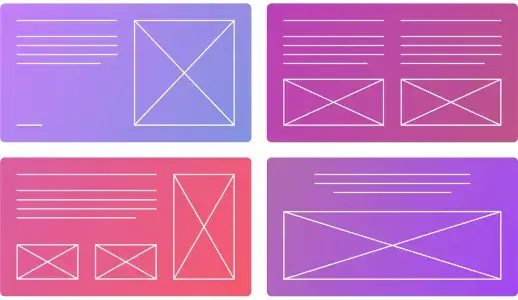
While there are far more than four web layouts as depicted in the above image, those are the most common types that you will see everywhere. They include one-column, two-column, multiple column, and F-layout.
Fundamental components of a website layout
Let’s explore the fundamental building blocks of web design page. These are the essential elements that form the foundation of the ideal web layout.
1. Header
The first and most visible element is the website header. A good header should be visually appealing as it can be the start of how a website drives business. This is because it includes access to the most important pages, include navigation options, and the brand’s logo.
2. Navigation
We talk about website navigation often in our blog posts because it’s a crucial element that allows visitors to find what they are looking for. So, to enhance user experience, navigation should be easy and simple. The location of a navigation menu is equally important, especially for mobile devices. In this case, the menu is generally accessible from a hamburger-like icon or a clearly defined button. Additionally, menu items should be logically organized as well as maintain consistency throughout the site.
3. Content area
The content area is the main section of a web page where all information is displayed. This area should be well-thought out and include headings, subheadings, paragraphs, and images to help organize and break up blocks of text. The website designers at Envisager Studio make use of white space to ensure readers can easily follow and digest content.
4. Sidebar
Sidebars can be located on the left or right side of the main content area. This is an option section, but can be used to provide additional information to support the main content. For example, websites with many service pages can use the sidebar to display the list of services as a sub-navigation menu. In addition to providing a great user experience, the sub-navigation keeps all services in view.
5. Footer
As the name indicates, the footer is located at the bottom of the website on every page. In general, it contains elements like quick links to important pages, social media, and sometimes an email signup form.
Key Takeaways
What makes a website convert requires understanding basic design principles, user requirements, and effective web layouts. At Envisager Studio, our web designers know how a website drives business success. In short, we focus on the core web page components, including responsive design, accessibility, and optimization best practices.
Not sure why your small business website is not driving conversions? Contact our web design and marketing team today for a website audit and design quote.
You may also enjoy reading: Why Hire a Virtual Assistant?

Christina Davis
WEB CONTENT DIRECTOR
Christina is the Web Content Director at Envisager Studio. She leads the content creation process and ensures tone and key messaging personifies the client’s brand and engages target markets. In her spare time, she writes about content marketing, content management, and website content.
Related Posts